
How Do You Convert Fabric Yardage to Meters for Sewing?
Staring at an international sewing pattern, you’re not alone in feeling that twinge of panic when the fabric requirements are in a different unit than your local store sells. Let’s fix that confusion right now.
This guide will walk you through the simple math and the crucial fabric science behind it, covering the exact conversion formula, how fabric width and potential shrinkage affect your calculations, planning your cutting layout for minimal waste, and tips for buying fabric online across different markets.
What Does a Meter or a Yard of Fabric Really Mean?
Let’s start with the basics. A yard of fabric is 36 inches long. A meter is about 39.37 inches. When you wonder ‘how many inches in a meter of fabric,’ remember it’s just over three inches longer than a yard.
These numbers only tell you the length of the fabric you’re buying, running along the selvage edge. The width-like 45″, 60″, or 150cm-is a separate and crucial number. I always check both measurements before I buy. Also consider the bolt dimensions—the total amount on the bolt and its width. Those sizes affect how much fabric you can cut in one go.
Think of it this way. Comparing a yard to a meter is like holding a standard pillowcase next to a slightly longer European one. The feel in your hands is similar, but one gives you a bit more to work with.
You might also ask about ‘how many meters in 1 roll of fabric.’ There’s no standard answer. However, standard fabric sizes measurement defines common roll lengths and widths, which helps when comparing options. In my work with mills, I’ve seen rolls vary from 20 to 100 meters based on the fabric type and manufacturer. A roll of delicate silk is often shorter than a roll of sturdy polyester.
The Simple Math: Converting Yardage to Meters Step-by-Step
The conversion is straightforward. Use this exact formula: Meters = Yards × 0.9144. This is the number I use in the lab for precise calculations.
For quick mental math at the fabric store, multiply your yards by 0.91. It’s close enough for most sewing projects that use fabric meter dimensions. For example, 2 yards times 0.91 gives you about 1.82 meters.
Here is a handy reference for common small cuts. I keep a list like this pinned in my workshop.
You can use any yardage to meters calculator, but the key is knowing your starting yardage correctly. I always measure twice before I let the calculator do the work.
My top pro-tip is to always convert your pattern’s yardage to meters before you add any extra for shrinkage. Different fabrics behave differently. A crisp cotton voile might shrink 3-5%, while a springy wool jersey could shrink 8%. If you add a shrinkage allowance to your yards and then convert, your math will be off. Convert first, then add the extra meters based on your fabric’s specific care needs.
Why Your Fabric Type Changes Everything (Beyond the Math)
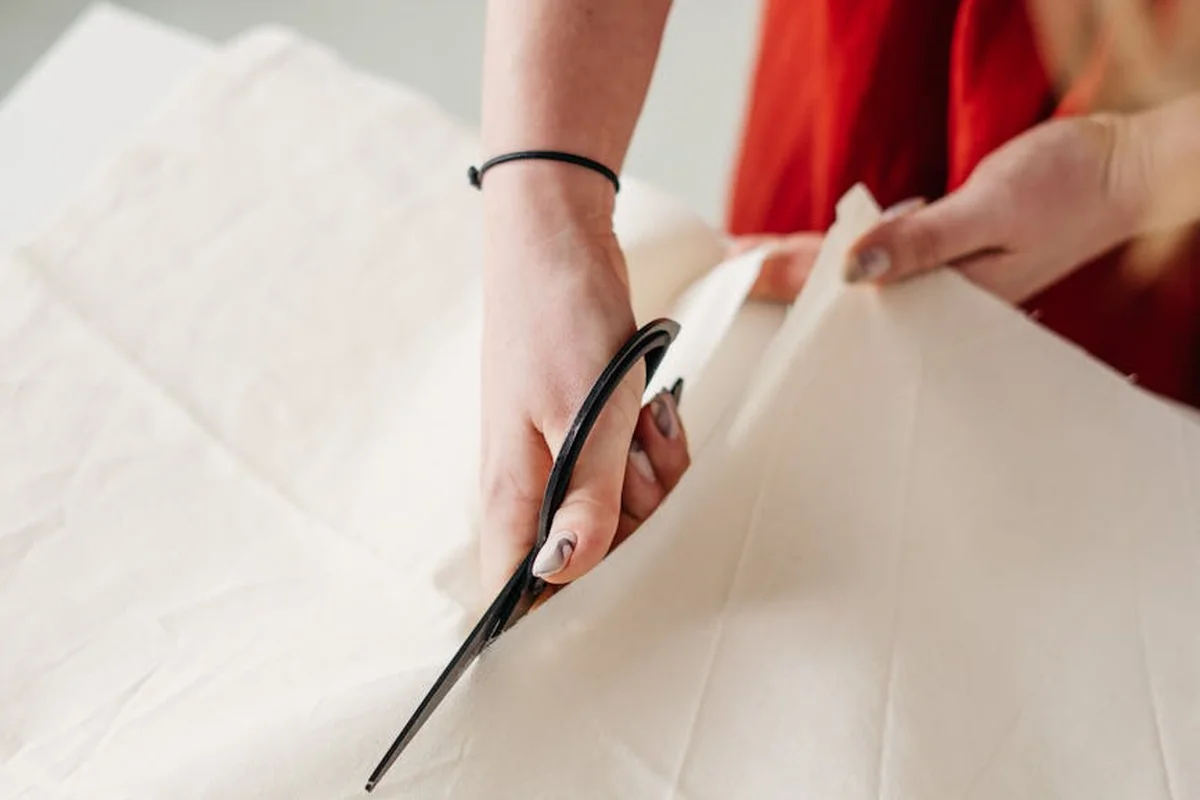
The conversion from yards to meters is simple arithmetic. The behavior of your fabric is not. A meter of wool does not equal a meter of cotton once it meets water and heat. Your most important job isn’t just converting units, it’s accounting for how much fabric you will lose before you even cut.
Think of shrinkage as a percentage of loss. A 2% shrink on a sturdy linen might just tighten the weave. A 10% felt on wool is a disaster, turning a garment into a stiff, miniature version of itself. You must calculate with the finished, post-wash size you need, not the size you are buying off the bolt—especially if you haven’t pre-washed the fabric to prevent shrinkage.
A Fiber-Specific Shrinkage Guide
This is where my lab experience meets your sewing table. Here’s what you can generally expect from major fiber types after a standard care cycle.
- Cotton and Linen (Plant Fibers): Expect 3% to 5% shrinkage. These fibers swell with water, and the tension from weaving or knitting relaxes. I always pre-wash these in warm water and tumble dry on medium to pre-shrink them completely. A “loom-state” or “greige” fabric can shrink even more.
- Wool (Animal Fiber): This is the high-stakes fabric. Wool can shrink drastically through felting, a permanent matting of the fibers caused by heat, agitation, and rapid temperature changes. For wool, assume you need significant extra yardage and only ever use cold water, gentle hand washing, and flat drying. I add a 10-15% safety buffer for critical projects.
- Silk (Animal Fiber): With gentle care (cold water, no wringing), shrinkage is minimal, often 1-3%. But silk is delicate and expensive; a calculation error is costly. I test-wash a swatch first. Always handle with care to preserve its beautiful drape and hand.
- Polyester, Nylon, and Common Blends (Synthetics): These are dimensionally stable, often showing less than 1-2% shrinkage. Pre-washing is still non-negotiable to remove factory finishes that can affect dyeing or adhesion. Their stability makes calculations easier.
Your Step-by-Step Calculation
Let’s walk through the real math. Never just convert your pattern’s yardage to meters. Convert the *adjusted* yardage that includes shrinkage.
- Find Your Finished Length: Start with your pattern’s needed length. Add your hem allowance. This is your target finished length (TFL).
- Apply the Shrinkage Buffer: Use this formula: Length to Buy = Target Finished Length ÷ (1 – Shrinkage Decimal). For a 100cm (TFL) cotton dress with 5% expected shrink: 100 ÷ (1 – 0.05) = 100 ÷ 0.95 = 105.26 cm.
- Now, Convert to Meters: You need to buy 105.26 cm. That is 1.0526 meters. In practice, you’d buy 1.1 meters. This final number is what you convert if your source uses yards. 1.1 meters ≈ 1.2 yards.
See the difference? If you just converted a 100cm (1.09 yard) requirement, you’d end up with a dress that’s too short after its first wash.
Applying This to Real Projects: From Lehengas to Quilts
Let’s use a common search, “how many meters fabric for lehenga,” as our case study. A lehenga skirt requires substantial fabric for volume. The calculation depends on the skirt’s fullness (circumference), length, and the fabric’s width (often 45″ or 60″).
If a pattern draft calls for 4 yards of 45″ wide silk for a full lehenga skirt, you don’t just convert 4 yards to 3.66 meters and order. You apply the silk shrinkage buffer first. For silk at 3%: 4 yards ÷ 0.97 = 4.12 yards needed. *Then* you convert: 4.12 yards ≈ 3.77 meters. You must also check if the online store’s fabric is 45″ wide or a different width, which changes everything.
Compare this to a quilt made from pre-washed cotton squares. Quilts have seam allowances and piecing, offering more forgiveness for slight variances. A fitted wool blazer has almost no forgiveness. The precision of your shrinkage math must match the precision required by the final garment.
The Width Factor
Fabric width is a silent partner in every calculation. Needing 2 meters of 60″ (152cm) wide fabric is a completely different amount of material than 2 meters of 45″ (114cm) wide fabric. Always note the width listed by the retailer. A pattern designed for 45″ fabric will not layout correctly on 60″ fabric without adjustment, and vice versa. Knowing the fabric bolt widths is essential for both quilting and apparel sewing.
Textile Expert’s Note: My rule for online shopping is this: if your pattern is in yards and the site sells in meters, do the entire calculation in one unit first. Convert your pattern requirement to meters, add your shrinkage and error buffer, *then* purchase. Never, ever cut it close. It is far better to have a spare half-meter for a future project than to be short a crucial strip of fabric. Your future self will thank you.
Your Conversion Toolkit: Methods, Mistakes, and Muscle Memory
Good conversion starts with the right gear. You don’t need much, but having these items on hand will make the process smooth.
Essential Physical Tools
- A clear quilting ruler with both inches and centimeters printed along the edges is invaluable. I keep one on my cutting table at all times for quick visual checks.
- A soft, flexible tape measure that shows both metric and imperial units. This is your go-to for measuring fabric off the bolt or checking your work.
These two simple tools eliminate guesswork and let you move fluidly between measurement systems.
The Digital Helper
Your phone’s basic calculator app is all you need. The math is straightforward: multiply yards by 0.9144 to get meters. I advise against specialized “craft converter” apps that can overcomplicate a simple multiplication. Sticking to the core calculation keeps you in control and helps you understand the relationship between the units, which is the real goal.
Common Pitfalls to Sidestep
Converting the number is one thing. Applying it correctly to real fabric is another. Here are the stumbles I see most often in the studio.
Confusing “Ease” with “Shrinkage Allowance”
This is a critical distinction. “Ease” is the extra fabric built into a clothing pattern for comfort and movement-it’s a design feature. A “shrinkage allowance” is extra fabric you must add yourself because the material will physically contract when washed.
You calculate your shrinkage allowance after you’ve converted your pattern’s yardage to meters and added any design ease. For a woven cotton that typically shrinks 3-5%, I’d add at least 5-10 centimeters per meter of length as a safety buffer. A quick look at a fabric shrinkage care guide can help you tailor this buffer for other fabrics. It also covers prewashing techniques to stabilize fibers before cutting.
Mixing Up Width and Length in Listings
Online fabric stores can list dimensions in different orders. A listing for “2m x 150cm” usually means 2 meters in length by 150 centimeters (1.5m) in width. Always double-check. Roll sizes tied to fabric widths vary by roll and supplier, so knowing the width helps you estimate how much fabric you’ll get per roll. When in doubt, remember that the fabric width (often 44″, 60″, 150cm) is usually the smaller of the two numbers after the length. This width directly impacts how you lay out your pattern pieces.
Skipping the Pre-Wash Swatch Test
This is the most important step you can take for accuracy. That linen or cotton voile won’t shrink like a standard quilting cotton. Always cut a 50cm x 50cm square from a new fabric, mark a 30cm line inside it, wash and dry it as you plan to care for the final garment, and then re-measure. This tells you the fabric’s true personality. A wool coating might felt and shrink 15%, while a polyester crepe might not budge at all. Your conversion and cutting plan must account for this real-world behavior, especially when using delicate fabrics like linen.
Building Confidence
With practice, this process becomes intuitive. You’ll start to visualize a meter as just a bit longer than a yard. You’ll automatically think about fiber content-a spongy cotton, a springy wool, a stable polyester-and how it behaves when you add water and heat to the equation. The goal isn’t perfect, robotic precision, but the confidence to buy and cut fabric knowing your project will fit as intended after its first wash. That confidence turns stress into satisfaction.
Beyond the Tape Measure: Fabric Behavior Essentials
After converting yardage to meters, I always pre-wash a swatch to test for shrinkage before I cut. This single practice shows you exactly how a crisp cotton will tighten or a springy wool might felt, ensuring your final dimensions are correct.
Your growing knowledge of fiber properties makes you a steward for your materials and our planet. Exploring silk fabrics—types, properties, and care—helps you handle each piece thoughtfully. When you care for silk’s delicate hand or wash polyester blends in cool water, you extend their life and sew with intention.
Citations and Authoritative Sources
- Convert Fabric Yardage to Meters – The Colour Blind Quilter
- Converting to Meters | Restoration Fabrics & Trims
- Yardage to Metreage Conversion
- Yard to Meter Conversion Table | iFabric
Florian Ventura
Florian is a high fashion blog writer, fashion and fabric expert and a keen expert in fabric, clothing and materials. She has worked in large textile and fashion houses for over 10+ years, engineering and working with various fabric types and blends. She is an expert when it comes to questions on any and all kinds of fabrics like linen, cotton, silk, jute and many more. She has also traveled around the world studying traditional fabrics and aims to bring them into the modern fashion use.